Key Takeaways
- Epoxy regrouting replaces failed cement grout with 100% waterproof epoxy grout without removing tiles
- The process takes 1–2 days for a standard shower with minimal disruption to your home
- All existing cement grout must be completely removed before epoxy application for proper bonding
- Professional epoxy regrouting comes with a 10-year warranty and lasts 20+ years
What Is Epoxy Regrouting?
Epoxy regrouting is a professional shower repair technique that replaces failed cement grout with premium waterproof epoxy grout — without removing your existing tiles. It's the most popular method for repairing leaking showers in Sydney because it's effective, affordable, and minimally disruptive.
The process addresses the most common cause of shower leaks: deteriorated cement grout that allows water to penetrate behind tiles. By replacing porous cement grout with 100% waterproof epoxy grout, the shower's water barrier is restored at the tile level.
Thousands of Sydney homeowners have chosen epoxy regrouting as their preferred shower repair method. It's fast, it works, and it comes with a 10-year warranty that provides genuine peace of mind.
The Science Behind Epoxy Grout
Understanding the material science explains why epoxy grout dramatically outperforms cement grout in wet areas:
Two-part chemical reaction: Epoxy grout consists of an epoxy resin (Part A) and a hardener (Part B). When mixed in precise proportions, they undergo an exothermic chemical reaction (cross-linking polymerisation) that transforms the liquid mixture into an incredibly hard, dense, non-porous solid.
Zero porosity: Unlike cement grout, which contains microscopic pores that absorb water, cured epoxy grout has virtually zero porosity. Water cannot penetrate into or through properly cured epoxy grout — it's as waterproof as glass.
Chemical resistance: The cross-linked polymer structure resists degradation from cleaning chemicals, body care products, and minerals in water. Substances that dissolve cement grout over time have no effect on epoxy.
Flexibility: Cured epoxy grout has a degree of flexibility that allows it to accommodate minor building movement without cracking. This is a crucial advantage over rigid cement grout, which cracks under thermal and structural stress.
Non-organic surface: Mould and bacteria cannot colonise the non-porous surface of epoxy grout. There are no pores for organisms to anchor to and no moisture for them to feed on. This is why epoxy-grouted showers stay cleaner and more hygienic for longer.
The Epoxy Regrouting Process Step by Step
Professional epoxy regrouting follows a precise, systematic process:
- Inspection — assess the condition of tiles, existing grout, and the substrate. Confirm that epoxy regrouting is the appropriate repair method.
- Protection — mask and protect all bathroom fixtures, surfaces, and adjacent areas.
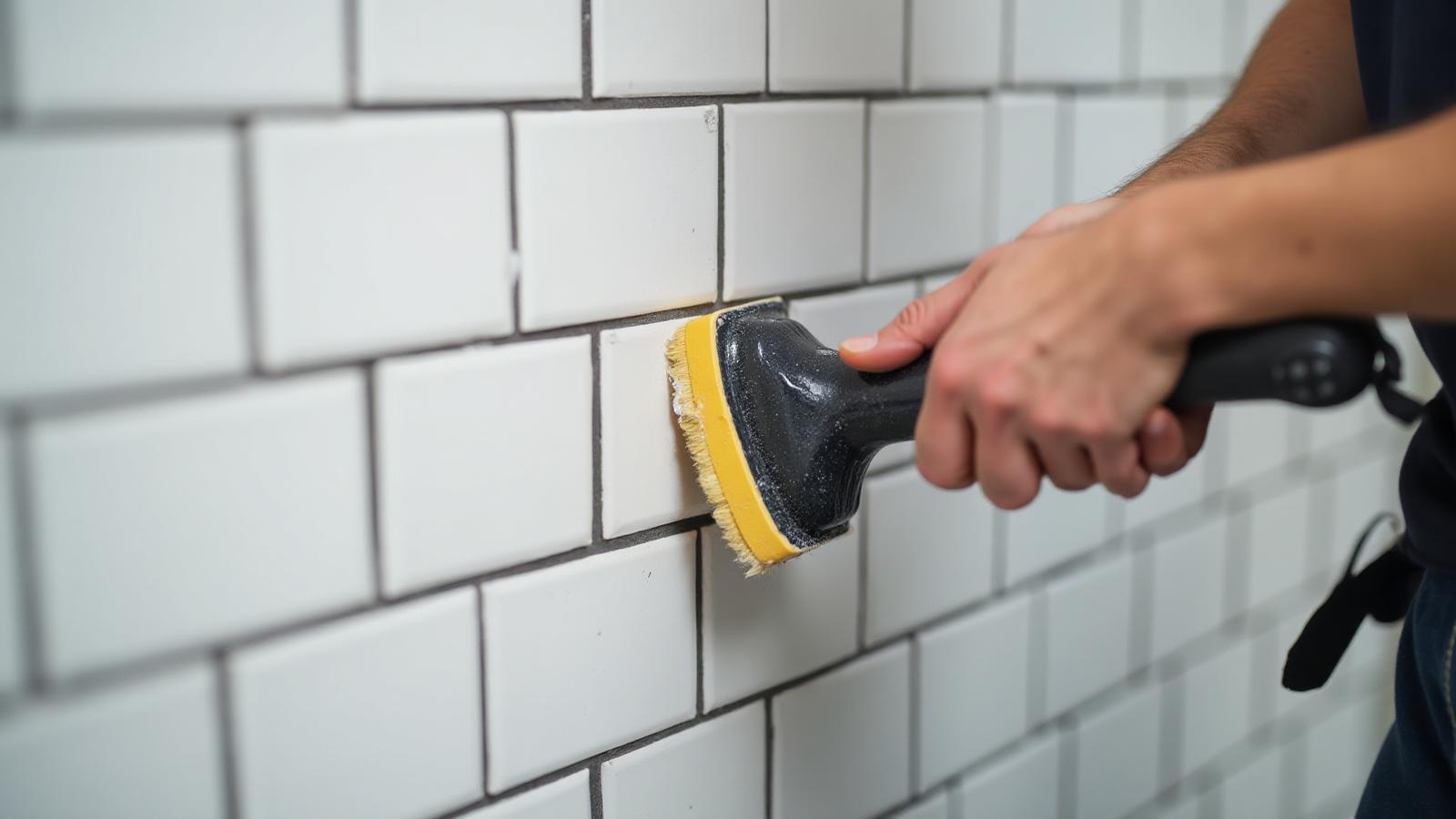
- Grout removal — all existing cement grout is carefully removed using precision oscillating tools. Every joint is cut to full depth to ensure complete removal.
- Surface preparation — tile edges are cleaned, and any loose material or residue is removed. The substrate is treated as needed.
- Epoxy grout mixing — the two-part epoxy system (resin and hardener) is mixed to exact manufacturer specifications.
- Application — epoxy grout is carefully packed into all joints, ensuring full contact with tile edges and complete filling.
- Finishing — joints are tooled to a smooth, consistent profile. Excess grout is removed from tile faces.
- Silicone replacement — all silicone at junctions, corners, and penetrations is removed and replaced with premium bathroom-grade silicone.
- Final inspection and cleanup — the completed work is inspected, the area is cleaned, and the homeowner is briefed on curing requirements.
Before and After: What to Expect
One of the most satisfying aspects of epoxy regrouting is the dramatic visual improvement:
Before: Cracked, discoloured, mouldy cement grout. Tiles may look dull and dated. Musty odours from moisture trapped behind deteriorated grout. Possible water stains on ceilings or walls below.
After: Clean, uniform grout lines in your chosen colour. Tiles appear brighter and refreshed. No more musty odours. Waterproof seal that prevents moisture penetration. Easier to clean and maintain.
Many of our clients tell us their bathroom looks "almost new" after epoxy regrouting — and that's without changing a single tile. It's one of the most cost-effective bathroom improvements you can make.
Colour options: Modern epoxy grout is available in a wide range of colours. You can match your existing grout colour for a seamless look, choose a contrasting colour for a design statement, or select a darker shade that hides everyday grime better than light-coloured grout.
Common Mistakes in DIY Epoxy Regrouting
While DIY epoxy grout kits are available at hardware stores, professional application is strongly recommended. Common DIY mistakes include:
- Incomplete grout removal — leaving old cement grout in the joints prevents proper epoxy adhesion. Every millimetre of old grout must be removed for the epoxy to bond correctly.
- Incorrect mixing ratios — epoxy requires precise proportions. Too much or too little hardener results in grout that doesn't cure properly, leaving it soft, sticky, or brittle.
- Working too slowly — once mixed, epoxy grout has a working time of 30–45 minutes. Attempting to do too large an area at once means the epoxy begins to set before application is complete.
- Poor cleanup — epoxy residue left on tile faces cures to a hard, difficult-to-remove haze. Professional technique ensures clean tile surfaces.
- Missing the silicone — regrouting without replacing silicone at corners and junctions leaves critical gaps in the waterproof barrier.
- Uneven joints — achieving consistent, smooth grout lines with epoxy requires experience and specialised tools.
The cost difference between DIY ($150–$250 for materials) and professional ($500–$900 including warranty) is modest compared to the risk of a failed DIY attempt — which may require a professional to redo the entire job.
Why Choose Epoxy Regrouting Over Other Repair Methods
Epoxy regrouting offers several compelling advantages over alternative repair approaches:
- No tile removal — your existing tiles stay in place, preserving your bathroom's appearance
- One-day completion — minimal disruption to your household
- Cost-effective — significantly cheaper than membrane repair or full re-waterproofing
- Permanent waterproofing — epoxy grout is 100% waterproof, unlike cement grout
- Mould prevention — non-porous surface doesn't support mould growth
- Long-lasting — 20+ year lifespan with a 10-year warranty
- Improved appearance — fresh, clean grout lines rejuvenate your bathroom's look
We provide epoxy regrouting services across all Sydney suburbs including Bondi, Chatswood, Parramatta, Cronulla, and Surry Hills. Book a free inspection or read our complete guide to leak repairs for more information.
Caring for Your Shower After Epoxy Regrouting
One of the best things about epoxy grout is that it requires minimal maintenance. However, following these simple guidelines maximises its lifespan:
First 7 days (curing period):
- Wait 24–48 hours before using the shower
- Avoid harsh cleaning products during the first week
- Don't scrub the new grout aggressively
Ongoing maintenance:
- Clean with any household bathroom cleaner — epoxy grout is chemically resistant
- A squeegee after showering reduces water marks but isn't essential
- Inspect silicone seals every 6–12 months (the most likely maintenance item)
- No re-sealing is ever required — epoxy grout is permanently waterproof
Compare this to cement grout maintenance: regular sealing, careful product selection, frequent mould treatment, and eventual replacement. Epoxy regrouting isn't just a repair — it's an upgrade that simplifies your bathroom maintenance for decades.
People Also Ask
Peter Kim
Lead Technician — Leak Repair Specialist
Over 15 years of experience in shower and balcony waterproofing solutions across Greater Sydney.